The test
What is HeliosOne™?
HeliosOne™ is a blood test that shows how your whole body, and each of your organs, is aging. From one small sample we measure about 1,000 proteins, then turn them into biological ages and disease-risk scores, with clear next steps you can take with your physician.
How do I take the test?
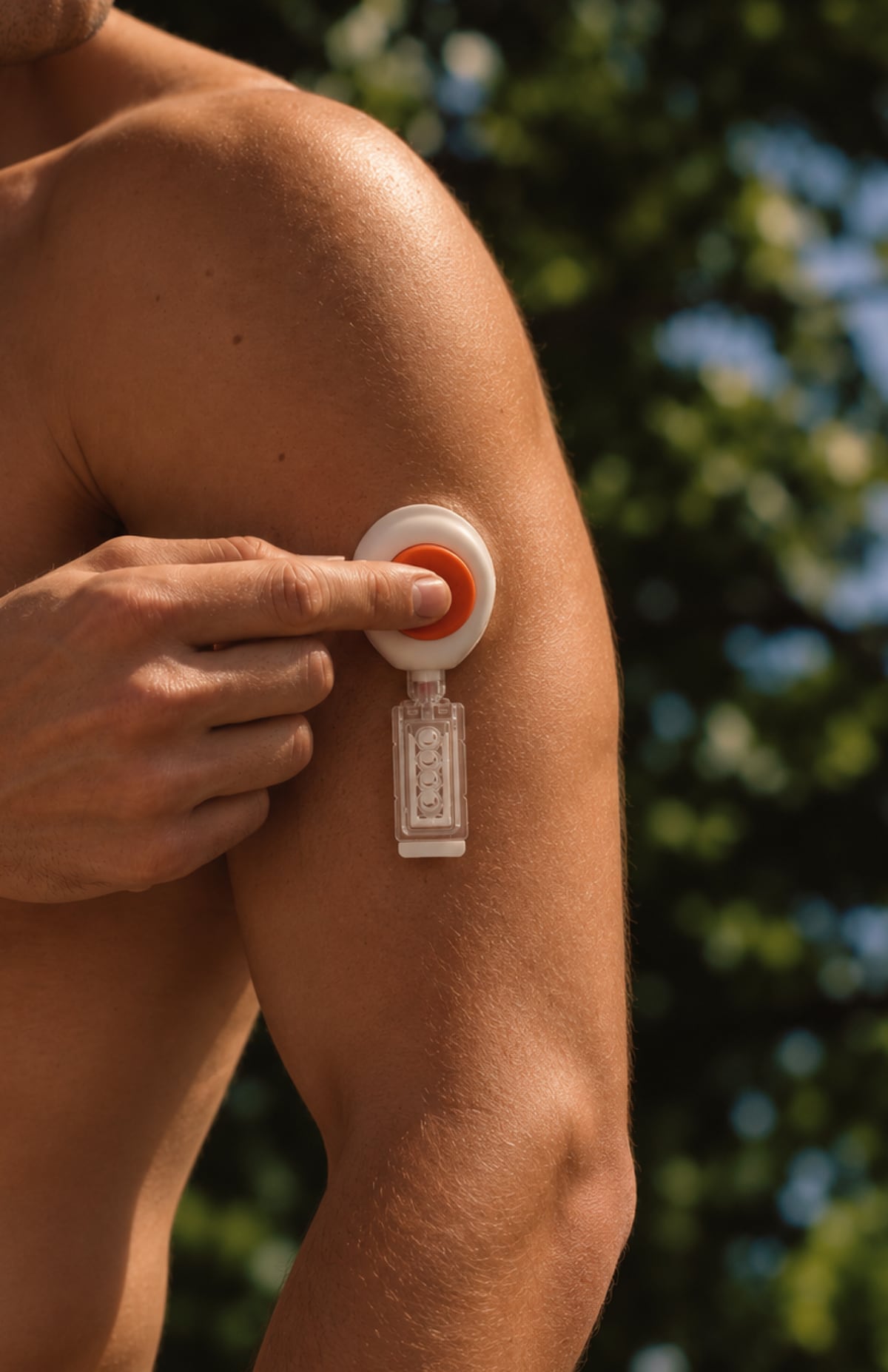
You place a small device on your upper arm and press the button. It collects a few drops of blood from your capillaries, at home or at a clinic. You send the sample to us and we send you the results back.
Is it really just a drop of blood?
Yes. The device collects about 70 µL of blood, roughly one and a half drops, across four small pads. Our assay uses only a fraction of that sample, so the measurement itself runs on less than a single drop.
Does it hurt?
The device is designed to be virtually painless. It uses a tiny lancet on your upper arm instead of a needle in your vein, so there’s no blood draw and no visit to a phlebotomist.
Are a few drops of blood from my arm as good as a regular blood draw?
Yes. In our side-by-side testing, blood from the device measured as many proteins as a venous draw, at closely matching levels, and was unchanged after a week at room temperature. Our models are trained on samples from this same device, so the scores already account for small differences from a venous draw.
How is this different from my annual blood work?
The HeliosOne test doesn’t replace your annual blood work. Routine labs, such as metabolic panels, cholesterol, and blood counts, are clinically validated to diagnose and monitor disease, and you should keep getting them as your physician recommends.
Helios adds a deeper view. Because standard labs are designed to flag disease, they often come back normal in otherwise healthy people and stay that way, even as biology shifts beneath the surface. Helios measures about 1,000 proteins at once, most of which aren’t available on standard lab panels, including signals of cellular stress, tissue remodeling, brain health, and gut-barrier integrity. These signals can shift in response to changes in sleep, nutrition, exercise, and other interventions, giving you a way to see how your body responds, well before anything would show up on routine labs. Beyond individual values, we read the pattern across all of them to estimate how your organ systems are aging and highlight where risk may be building.
Helios isn’t designed to diagnose disease. It’s designed to give you and your physician earlier, broader insight into your health and clear next steps to act on.
Your results
What do I get back?
A biological age for your whole body and for individual organs, cells, and systems; risk scores for the diseases those ages predict; and the proteins driving each score. Our AI agent then suggests next steps, such as lifestyle changes, follow-up tests or treatments, and cites the published studies behind each one. Your physician decides what to act on.
With 1,000 protein biomarkers, won’t something always look off?
Any single out-of-range protein can be chance, so no score rests on one protein. Each score combines many, which keeps one noisy value from moving it far, and your report shows which proteins drive it.
Can I change my results?
Yes. Blood proteins respond to what you do. Published studies show clear protein changes after endurance training, weight-loss medicines, calorie restriction, statins and some supplements. Across 16 clinical datasets, our whole-body age score fell on average in people who responded to treatment and rose in those who got worse.
How often should I retest?
It depends on your goals. Most people retest monthly, quarterly or twice a year, depending on how closely they want to follow their action plan, the changes in their body and their longevity trajectory.
To see what one specific change is doing, such as a new medication, supplement or diet, test before you start and again after. That gap can be as short as a week: in a clinical trial dataset, our whole-body age score fell within a week of an effective treatment.
Science and safety
How do you know the scores are accurate?
We start by teaching our models what a typical body looks like at each age. Your biological age is where your proteins place you on that scale. If it’s higher than your actual age, your body is aging faster than expected. We build these ages and scores for your whole body and for individual organs, tissues, cell processes and pathways. There are 71 today, and the number keeps growing: we continue to train, test and validate new models, and we add them to your results as they’re ready.
To test whether they matter, we applied every one, without changes, to an independent group of more than 40,000 people whose health has been followed for more than a decade.
All 71 scores predicted future disease and death. The whole-body score predicted 20 of 23 common diseases, including liver disease, kidney disease, heart failure, diabetes, dementia and a common form of leukemia, and on most of them it outperformed two published aging clocks built on that same group.
A single whole-body age can’t tell you everything, which is why we build scores for specific organs and processes. Alzheimer’s disease is a good example. The whole-body score picks up only a small part of its risk, but our brain score, built from proteins that reflect stress in brain cells, predicted Alzheimer’s far better, matching the best published brain clock.
Across all conditions, our scores predicted risk for more than 200 diseases.
Who is the test for?
Adults who want to understand how they’re aging and act early. Our own dataset spans ages 20 to 80.
Is HeliosOne a diagnostic test? Is it FDA-cleared?
No. HeliosOne is a laboratory-developed test, the route most specialty lab tests take, and it is not FDA-cleared. It will run in a CLIA-certified laboratory, and we expect to complete CLIA validation in the first quarter of 2027. Scores support clinical judgment; they are not diagnoses.
Does it screen for cancer?
No. Some of our scores predict future risk of certain blood cancers, but the test does not screen for cancer.
For clinicians
How can I offer Helios to my patients?
Tell us about your practice through Offer the Test and our partnerships team will be in touch within one business day. Helios will soon be offered at clinics around the US.
How do the next-step suggestions work?
The Helios AI agent is interactive. Patients can ask it questions about their results, such as what a score means, why it changed or which proteins drive it, and explore their own data in depth. It also provides recommendations at two levels. For each score, it identifies the proteins driving the result and follows published evidence from human studies to the interventions shown to influence them, producing score-specific suggestions across lifestyle, nutrition, supplements, and follow-up care. It then looks across all of a patient’s scores together to build a whole-person plan, prioritizing steps that support several systems at once and avoiding those that would improve one score at the expense of another.
The agent draws on a knowledge graph built from more than 70 curated public datasets and citing more than 80,000 papers. Every suggestion links to its primary sources so clinicians can review the evidence directly. A link reflects a published association, not proof that an intervention will cause a change in an individual patient.
Will the scores transfer to my patients?
Our validation is a strong test of that. We built the scores on our assay, and they still predicted disease in an independent group whose blood was measured on a different platform. Scores that only fit one assay’s quirks would not transfer that way.